 Don Draper
UNCLASSIFIED
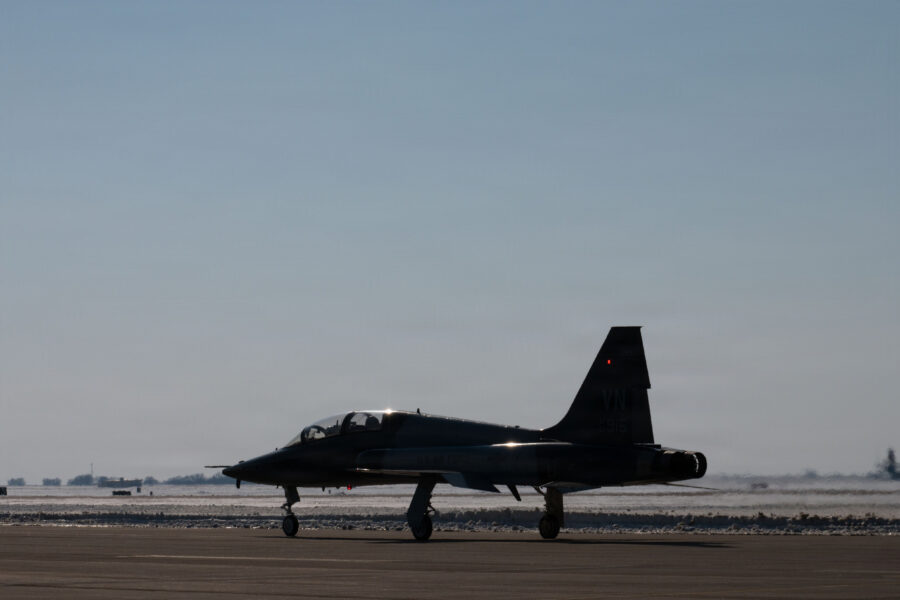
The crash of a T-38 trainer jet this May—which caused a weekslong pause in flights across the fleet—was caused by an improperly installed pin for one of the jet’s horizontal stabilizers, according to a new accident report released Oct. 30. When the pin disengaged midflight, it created the slightest amount of “play” in the system, which in turn caused aerodynamic flutter that shook the aircraft until both stabilizers were ripped off.
The aircraft was destroyed in the mishap, with the loss valued at $11.3 million. The USAF instructor and international student pilot successfully ejected and suffered minor injuries.
Investigators determined the contractors responsible for maintenance on the T-38 out of Columbus Air Force Base, Miss., failed to perform a check for play, or “backlash,” after installing a new actuator during unscheduled work in the weeks before the crash, and their supervisors missed the mistake.
“The contractors signing off the actuator installation, the work center supervisor, the Impoundment Official, Quality Assurance personnel, and the Impoundment Release Authority had the opportunity and capability to identify this missing required check, but did not,” the president of the Accident Investigation Board concluded.
The investigation also cleared the crew of contributing to the mishap in any way.
A Tenth of an Inch
The T-38’s horizontal stabilizers control the pitch of the aircraft’s nose, driven by two actuators on either side. The actuators work against each other to twist steel torque tubes so that the stabilizers remain in tension and don’t flutter.
All it takes to disrupt this system is a little bit of wiggle—no more than 0.1 inches of play or backlash in the actuator, according to a technical report reviewed by investigators. Once that happens, the torque tubes can lose tension and the stabilizers can start to flutter, “an aerodynamic feedback loop where fast-moving air increasingly shakes an aircraft structure until it breaks,” the report explained.
That’s what happened just before noon on May 12, after a fourship of T-38s took off from Columbus as part of a fighter-bomber fundamentals training sortie. The group was just starting with a G-warmup turn when the instructor and student in one plane heard a loud noise and the aircraft began to shudder. They then “reported strong vibrations and negative G, with the [student pilot] being lifted out of his seat,” the report states.
The instructor pilot took control of the aircraft and tried to level off, but the noises and shudders continued, followed by an “uncommanded pitch downwards with a spike in negative G.” Even with the control stick pulled fully back, the report noted, the aircraft continued to plunge downward—the horizontal stabilizers had been ripped off.
The ejection wasn’t completely smooth. While the instructor pilot got out cleanly, one of the student pilot’s leg restraints was later found to be twisted, and he reported pain in his left calf.
The aircraft, meanwhile, hit the ground in rural Alabama and became a fiery wreck.
Maintenance
A month prior to the mishap, the T-38 in question had been impounded “for an uncommanded 130-degree roll to the right,” according to the report. In attempting to troubleshoot the issue, maintenance personnel removed and reinstalled the aft fuselage, sometimes called the boattail, and discovered that the right horizontal stabilizer’s travel, or range of motion, was “out of limits.”
Maintainers performed a backlash check on the right stabilizer, but then subsequently determined the left stabilizer’s actuator also had “excessive play.” The actuator was removed, repaired, and reinstalled—but crucially, personnel never performed another backlash test.
Instead, maintainers ran checks to ensure the “travel” or range of motion on both right and left stabilizers was within limits and, with a few other checks and repairs, released the T-38 from impound. On May 1, the jet cleared a restricted check flight.
The accident investigation board did not conclude why the crucial backlash check never happened but faulted the entire maintenance team for “compliance failures.”
The Air Force Research Laboratory ran an analysis of all the recovered bolts, nuts, and pins from the mishap, and determined they had all failed because of the “overload” of the flutter. But investigators did not recover the aft actuator pin for the left horizontal stabilizer, and they noted that its “nut and stud remained riveted … with intact threads,” suggesting the pin had been under-torqued and came loose.
Investigators did not give any possible explanation for why the pin had been under-torqued.
Weekslong Pause
A week after the May 12 crash, on May 19, the Air Force announced a fleetwide operational pause affecting units within Air Education and Training Command, Air Combat Command, Air Force Materiel Command, and Air Force Global Strike Command.
On May 28, the service lifted the operational pause as it began inspecting T-38s, with the goal of returning to flight within days.Officials offered no further updates after that.
The T-38—a supersonic trainer first fielded in the 1960s and used by the Air Force to teach future fighter and bomber pilots—remains one of the oldest aircraft in the USAF fleet, and officials cite problems maintaining it as a key reason the service needs to transition to the T-7A Red Hawk, a modernized advanced trainer.
The post T-38 Crash That Briefly Paused Flights Caused by ‘Under-Torqued’ Pin appeared first on Air & Space Forces Magazine.
Air, accident investigation board, AETC, Air Education and Training Command, Air Force Accident Investigation Board, Air Force mishaps, T-38 crash
Air & Space Forces Magazine