 Tyler Durden
Trump Says Iran ‘Making Up Fake’ Attacks In Hormuz To Drive Up Price Of Oil
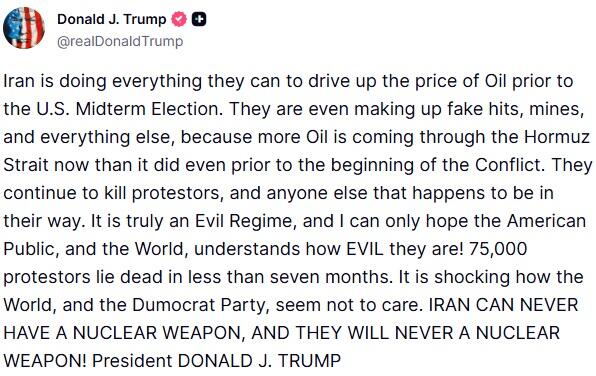
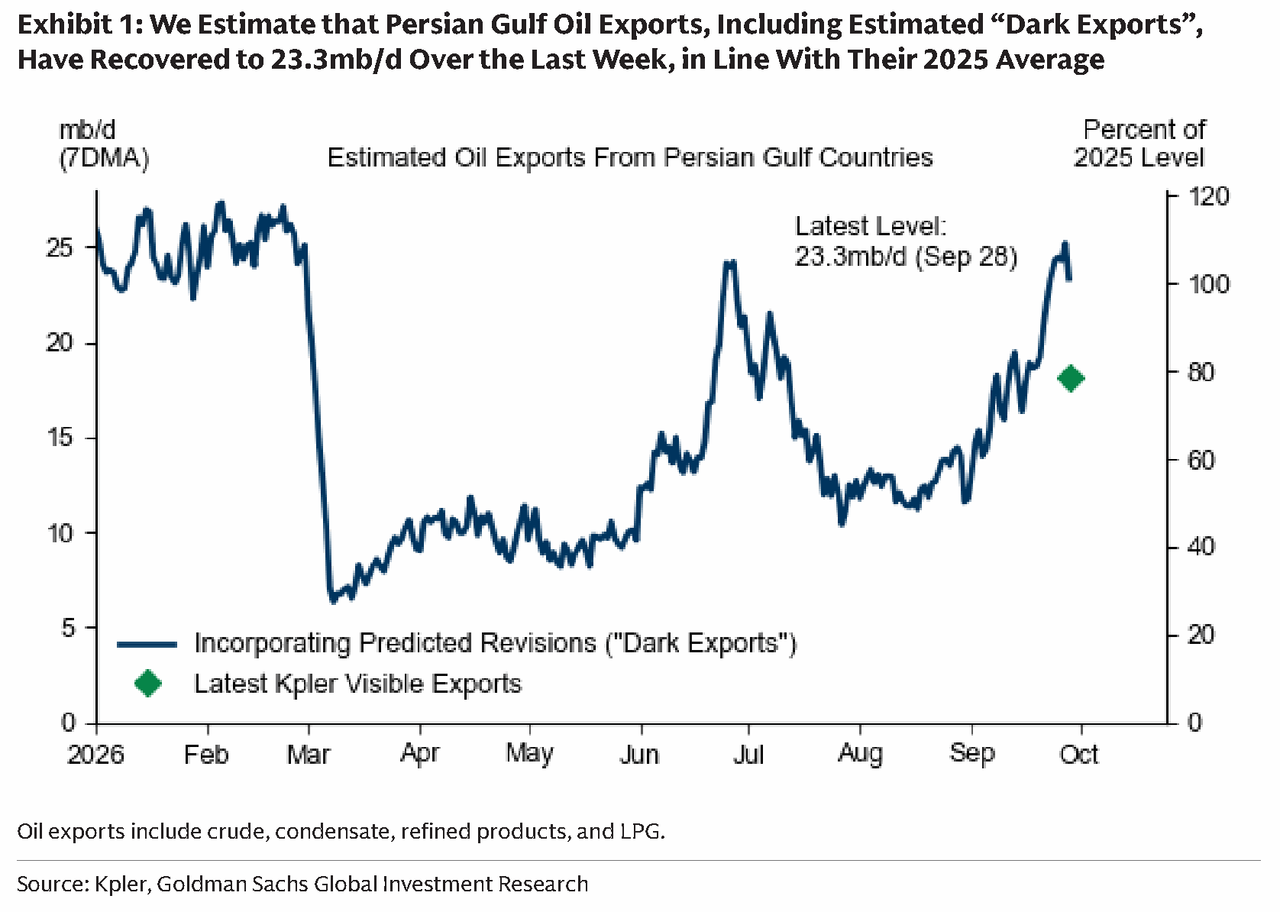
Update(1145ET): Amid fresh reports of the US and Israel drawing up plans to attack Iran after the November midterm elections, President Trump has issued a new Truth Social post, saying Iran is doing everything possible to try and drive up oil prices – suggesting “fake hits” and daily reports of mine explosions – but while also touting the US naval escort mission which has seen “more oil coming through the Strait of Hormuz than it did before” the conflict, which as we highlighted is accurate. He further repeats the highly dubious ‘75,000 protesters killed’ number, and stresses that Iran can never have a nuclear weapon.
This also comes as Netanyahu has freshly claimed Iran is bent on creating a nuclear weapon, emphasizing he wants to see regime change in Tehran.
Strait traffic dramatically rebounded over the last month:
🔺 Iran says it hit 7 vessels in the Persian Gulf and Strait of Hormuz as Brent crude surges to $112. 🔹Iran’s Islamic Revolutionary Guard Corps (IRGC) Navy said Thursday that its forces simultaneously struck four vessels conducting ship-to-ship oil transfers in the northern Persian Gulf, leaving all four burning. Three other vessels hit naval mines west of the Strait of Hormuz overnight, caught fire and came to a halt, according to the IRGC. 🔹The IRGC said the four vessels had used shipping routes it had declared prohibited, despite Iranian warnings. It accused the U.S. military of encouraging ships to cross mined routes, and warned that further U.S. involvement could prompt attacks on American bases across the region. 🔹As Brent crude rose nearly 3%, U.S. President Donald Trump accused Iran of “making up fake hits, mines, and everything else” to drive up oil prices before the midterms, claiming “more Oil is coming through the Hormuz Strait now than it did even prior to the beginning of the Conflict.” The UK Maritime Trade Operations agency, however, recorded more than two dozen attacks on ships in October, a record, and said a “majority” of vessels attacked were not reporting incidents.
— Drop Site (@DropSiteNews) October 22, 2026
* * *
At this point it seems both sides believe another major round of the US-Iran war is imminent. There’s been ample speculation of late whether President Trump will initiate another bombing campaign before or after the November midterm elections.
The White House may throw its hands up in the air and reason that Republicans are going to do bad in the elections anyway, and a pre-election bombing could be a Hail Mary effort at resetting the board, though one that will probably make it worse for the US force posture in the Middle East.
At the moment, the US State Department is evacuating further diplomats and their families from the embassy in Saudi Arabia, as Houthi attacks keep threatening airports, energy sites, and cities. A heightened state of alert is in effect for American citizens across the whole region.
Fresh reporting in the NY Times says indicates a renewed bombing campaign is likely to happen after the elections on November 3. The US and Israeli militaries have drawn up detailed plans for an attack, The New York Times reported on Wednesday evening, citing American officials.
It indicates that the plans focus on a short, intensive military operation that could last approximately three days – though we’ve all seen how ‘trustworthy’ these war timelines have been.
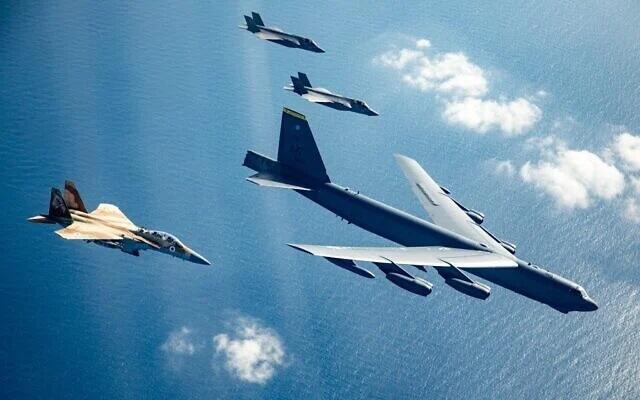
The NYT report notes, “As planning for a short but intensive operation progresses, the U.S. and Israeli militaries have stepped up exercises, flying planes over Iraq to practice strike maneuvers. Defense Secretary Pete Hegseth met with Prime Minister Benjamin Netanyahu in Israel this week to discuss new strikes, U.S. officials said.”
There has been increased aerial activity spotted over Iraq and Syria over the last days as well. These are speculated to be practice bombing runs.
For all the planning, even the NYT must point out: “Still, there are reasons to be skeptical that a renewed war would be any more successful than the first phase of intense U.S.-Israeli strikes between February and April. Those rounds of fighting drove up energy prices and inflation around the world, eroded security in the Middle East and severely strained the Pentagon’s supply of missile interceptors.”
This seems yet more ‘bombing campaign in search of a strategy’. It remains anything but clear what the admin’s ‘mission accomplished’ endpoint in Iran will be.
Israeli jets violates Iraq’s sovereignty to fly near Iran’s borders, sending a message and Iran responded by testing a new missile, sending a similar message: come, we are ready. https://t.co/L1IX5g9U8P
— Elijah J. Magnier 🇪🇺 (@ejmalrai) October 21, 2026
Iran has been defiantly signaling that it is ready for a prolonged campaign, and has at times boasted that it has kept up its missile and drone production throughout the entirety of the lull in fighting since at least mid-summer. Given we are month number eight of this quagmire, the following lines in the NYT report are somewhat laughably naive:
So far, however, Iran’s negotiators have been unwilling to make concessions on the nuclear program, insisting on deferring that issue until later in the talks.
Some U.S. planners are convinced that an intensive three-day campaign could cause enough economic damage to change the Iranian position.
Iran’s top security official, Gen. Mohsen Rezaei, the Secretary of Iran’s Supreme National Security Council and personal representative of Supreme Leader Ayatollah Mojtaba Khamenei, has stated the following to Drop Site News:
“If the question is whether Iran still has the ability to continue missile and drone operations, the answer is yes,” Rezaei said in an exclusive written interview. “The United States has valuable assets in the region. In the event of war, cables, data centers and artificial intelligence facilities could also come within range. If the conflict begins again, we will have a broader plan.”
“Everyone must understand that action against Iran carries a cost,” he added. “If diplomacy can bring about that understanding, we prefer diplomacy. But if the war continues, Iran has the tools it needs to keep responding.”
President Trump declares that the US is not negotiating with Iran, says something will happen “soon.” https://t.co/9Gi4aXmST8
— OSINTtechnical (@Osinttechnical) October 22, 2026
So whatever US-Israeli attack plan is triggered, it is very unlikely to be confined to a mere few days, as US officials are claiming once again.
More Latest Developments
via Newsquawk…
-
For most of the war, Iran had an invaluable cushion: dozens of oil tankers holding millions of barrels of crude sitting safely in waters in Asia. Tehran steadily sold the oil to China, bringing in billions of much-needed cash. Now, that floating storage is gone. By mid-October, the reserves were fully depleted, according to analysts at Kpler, as a U.S. naval blockade prevented Iran from replacing the crude it normally sells to Chinese refineries. WSJ
-
The US ordered some diplomats and their families to leave Saudi Arabia because of the threat from Houthi militants, as the Iran-backed group carried out more strikes from Yemen; four people were killed in two attacks on an Aramco oil field and an airport in Saudi Arabia’s Eastern Province. BBG
-
The US and Israel have drawn up plans for renewed strikes on Iran after the midterm elections, with targets likely to include Iran’s energy infrastructure, nuclear facilities and missile and drone arsenals. NYT
-
Aramco told staff to leave its headquarters in Dhahran and work remotely. RTRS
-
Iran’s IRGC threatened US bases in the region if Washington keeps escorting ships through what it calls an “illegal” Hormuz route. BBG
- Saudi Arabia is in talks with foreign governments to give state-owned Aramco access to their strategic oil storage, as the kingdom seeks to make its supplies to customers more resilient during disruptions, Chief Executive Officer Amin Nasser said. BBG
Tyler Durden
Thu, 10/22/2026 – 11:47
ZeroHedge News
[crypto-donation-box type=”tabular” show-coin=”all”]