 Tyler Durden
CoreWe’ve Got Bills To Pay: Bernstein Sees $76 Billion Funding Hole At Imploding Neocloud
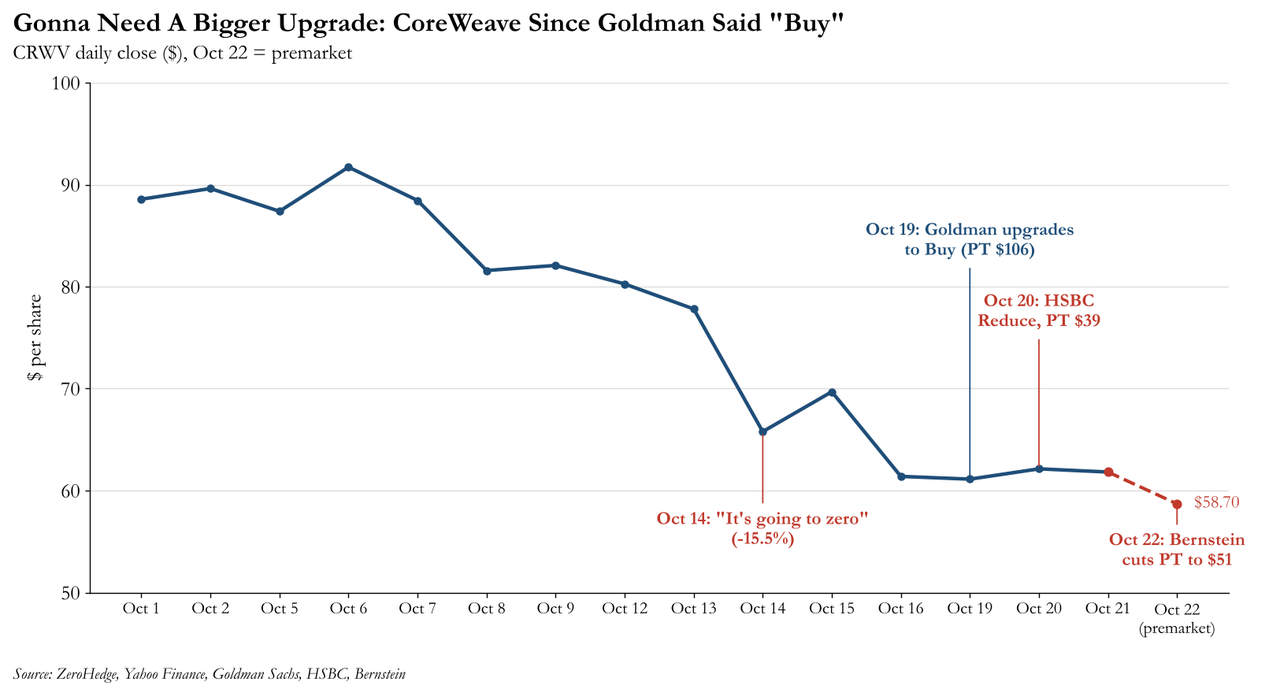
Goldman’s CoreWeave upgrade is three days old, and so far it has achieved precisely nothing.
On Monday, Goldman’s Gabriela Borges upgraded CoreWeave (CRWV) to Buy (in the process cutting her price target by almost a quarter) which is a creative way to turn bullish:
On CRWV, Goldman was Neutral with a $139 price target. it is now a Buy with a $106 price target.
— zerohedge (@zerohedge) October 19, 2026
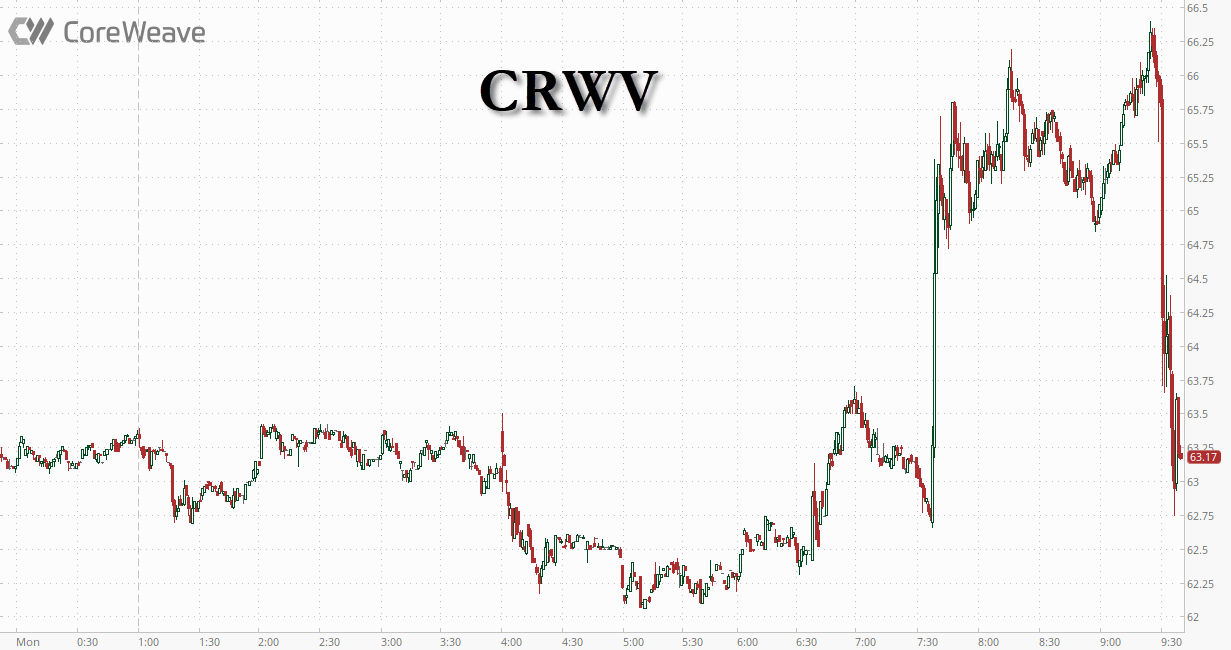
The stock spiked to $66 premarket and then, right after the open, gave back the entire pop, prompting us to note that Goldman was gonna need a bigger upgrade:
The opposite happened: a day later, HSBC tore apart Goldman’s bull case a new one with a $39 target (“the more it invests, the more the value destruction“), and this morning it’s Bernstein’s turn. CoreWeave is down another 8% this morning to $56.70, below where it traded before Goldman said “Buy”, and below the 52-week low of $57.24.
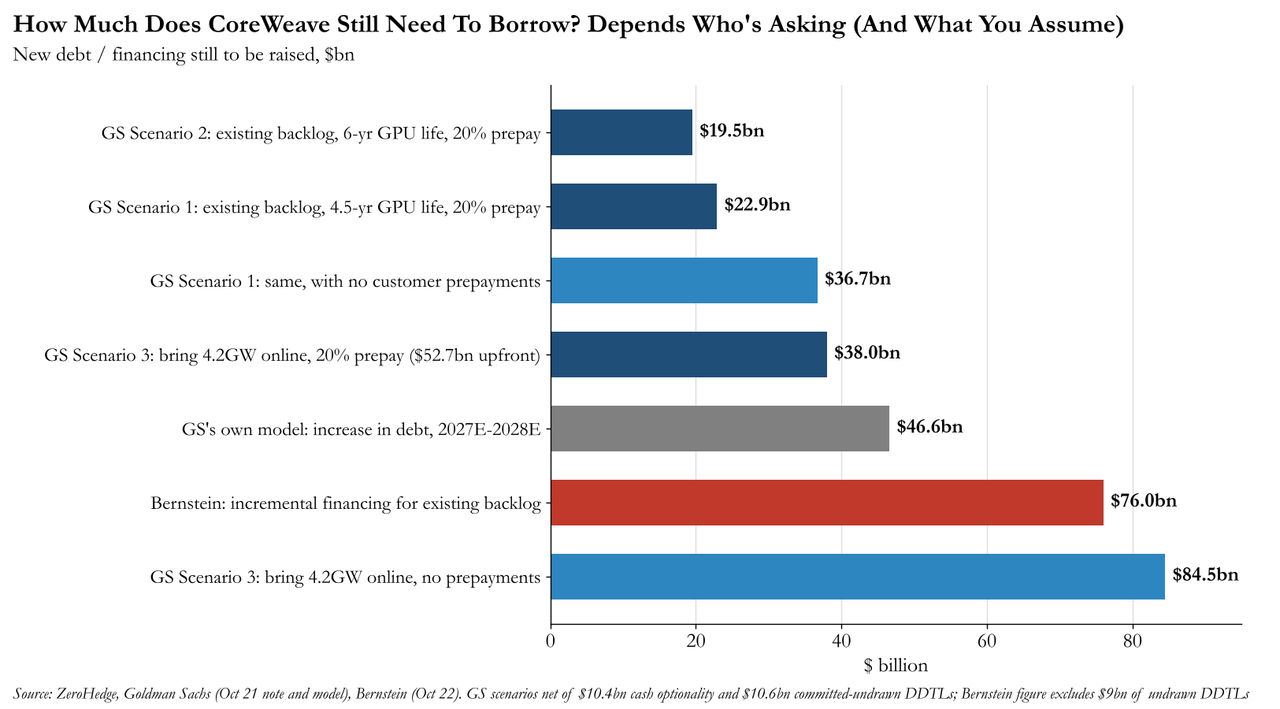
Goldman, meanwhile, doubled down. Late on Wednesday, Borges published a follow-up titled “How big is the funding gap?” (available to pro subs), because, in her words, “the primary question we have received from investors is around the magnitude and viability of future funding needs.” Her answer: about $23 billion. Bernstein’s answer, published a few hours later: $76 billion.
Somebody’s math is off by more than three times. Let’s figure out whose.
“Not Great, Not A Surprise”
Bernstein’s Madison Rezaei, who correctly had an Underperform on CoreWeave since initiating seven months ago, cut her price target to $51 from $74 in a note with what is hands down the best title of the year: “Core-We’ve got bills to pay… lowering our PT” (also available to pro subs). She also cut her target EV/EBIT multiple to 23.5x from 25.5x, “primarily reflecting concerns around its cost of capital, especially as the company moves to shorter-dated contracts.“
The note follows a week of what Rezaei describes as non-stop calls with “hedge funds, LOs, bulls, bears, credit people, REIT investors, and everybody in between.” The first question on everyone’s mind was the same one Goldman tried to answer, and Bernstein’s reply is refreshingly blunt:
“Not great, not a surprise. We estimate CRWV needs to raise $85B to fund the existing committed backlog, $9B of which is already covered by existing facilities. The unsecured credit market are still open to them at rates in the 15%+ range, given where the bonds are trading today, but we think there are a range of more reasonable options.”
In other words, $76 billion of fresh money just to deliver the compute CoreWeave has already sold, before signing a single new contract. And no, CoreWeave can’t simply stop growing its way out of the problem. Bernstein specifically addresses the investors asking whether the company could just slow spending and harvest cash:
“We distinguish stopping new contract wins from stopping investment: even without additional backlog, the company would still need to fund deployment obligations embedded in existing contracts, as well as maintenance and replacement requirements. Even a no-additional-backlog scenario would not produce immediate improvements in profitability given the funding requirements of existing contracts.”
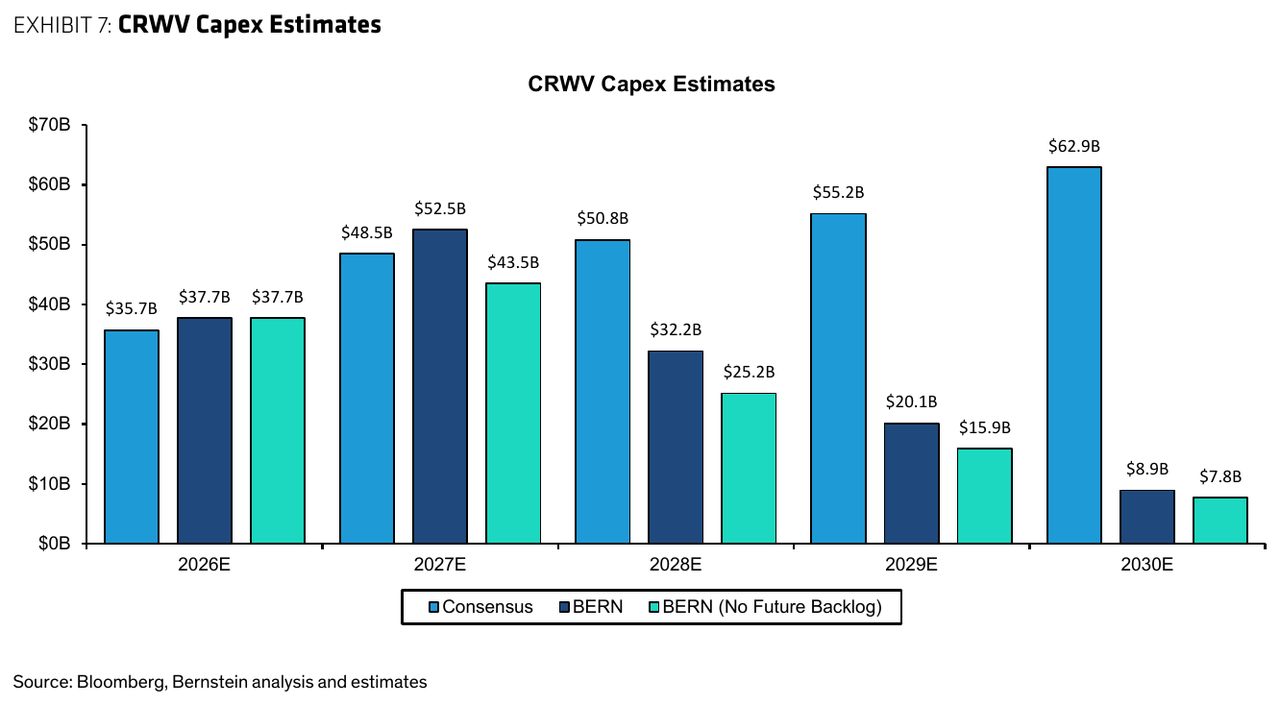
Bernstein models roughly $46 billion of growth capex next year to deliver existing backlog plus about $6 billion of maintenance capex, for a total of $52.5 billion in 2027, actually above consensus. And even in the “no future backlog” scenario, 2027 capex is still $43.5 billion. The good news, if you want to call it that, is that Bernstein’s capex falls off a cliff after 2027 because it is well below the Street on growth in 2028 and beyond. Bulls may not see it that way.
Bernstein also took an axe to earnings: its 2026 adjusted EPS loss widens to -$5.14 from -$4.56, and 2027 to -$6.81 from -$4.77, with adjusted losses persisting through at least 2029 in its model. That’s three more years of losses on top of the $76 billion.
Goldman’s $23 Billion Napkin
Now for Goldman’s version. Borges walks through three illustrative scenarios, and the headline (as per the title of her one and only exhibit) is that debt needed to serve existing $129 billion backlog “could be $20-23bn when including customer prepayments,” while ramping all 4.2GW of secured power would take about $38 billion.
Look a little closer at that table, though, and the number gets small mostly because of what goes into it. In Scenario 1, CoreWeave needs about $60 billion of capex to serve its backlog. Goldman assumes 80% can be debt-financed through DDTLs, subtracts $10.6 billion of committed-but-undrawn DDTL capacity and $10.4 billion of “cash optionality”, and arrives at $36.7 billion of new debt. To get to the headline $22.9 billion, it then assumes customers hand over 20% of total contract value up front, or $15.7 billion. Stretch GPU useful life to six years, and the number shrinks further to $19.5 billion.
A few problems with that:
- The prepayments are going the wrong way. By Goldman’s own admission, “CoreWeave’s prepayment percentages have come down in the last 6 months.” Goldman’s spin is that this “suggest[s] these percentages can also go up in an environment where there is less visibility into debt financing.” Translation: when CoreWeave can’t borrow, its customers will happily lend it the money instead. Maybe. Or maybe customers who just watched CoreWeave’s bonds trade at 15% decide they’d rather not prepay a counterparty with distressed debt.
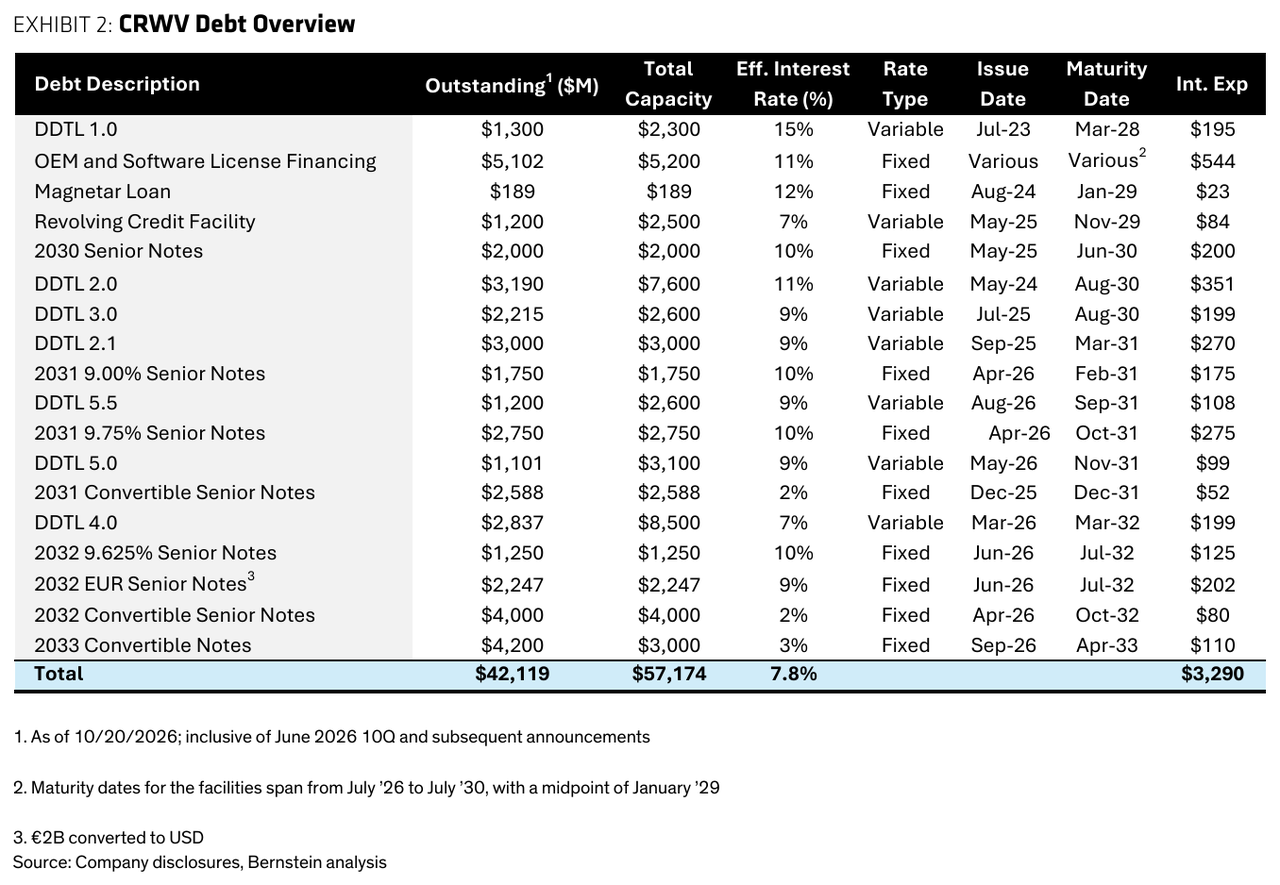
- The “cash optionality” is optimistic. The $10.4 billion includes $2.2 billion from selling 35 million ATM shares at $64, about 9% above where the stock trades this morning, and a $2 billion revolver. According to Bernstein’s debt table (as of Oct 20), $1.2 billion of the $2.5 billion revolver is already drawn, which would leave $1.3 billion.
- The 4.2GW number needs $52.7 billion of customer money. Scenario 3’s $38 billion assumes prepayments of $52.7 billion. Without them, the new debt needed is $84.5 billion, at a 94% debt-to-loan ratio, which is well above the 80% cap Goldman itself says the DDTL structure allows. Funny how that number didn’t make the title.
- There is no cost of capital anywhere in the note. Goldman calculates how much CoreWeave needs to borrow, but not at what rate, deferring to the “financing cost assumptions in our upgrade note” (the one with a 10% cost of new debt, about two-thirds of what CoreWeave’s unsecured bonds currently yield).
Here is the full range of answers to “how much does CoreWeave still need to borrow”, depending on whose spreadsheet you trust and what you assume customers will do:
To Goldman’s credit, the note ends with “Our worksheet is available on request and we welcome feedback on our assumptions.” Consider this our feedback.
Goldman’s Model Disagrees With Goldman’s Note
The irony is that the best rebuttal to Goldman’s funding note can be found on page 2 of the very same note, in Goldman’s own financial model. Ignore the illustrative scenarios and look at the cash flow statement, and Goldman has CoreWeave burning $28.2 billion of free cash flow in 2026, another $28.2 billion in 2027 and $15.8 billion in 2028, on capex of $38.6 billion, $48.0 billion and $49.9 billion. To fund that, Goldman’s model has debt increasing by $26.7 billion this year, $26.6 billion in 2027 and $20.0 billion in 2028. That’s $46.6 billion of new debt in the next two years alone, double the headline “funding gap”, and that’s before $50 billion of lease liabilities which Goldman models by 2028 (and which are, of course, debt by another name).
Long-term debt goes from $14.9 billion at the end of 2025 to $90.8 billion by 2028. Goldman’s interest coverage ratio for CoreWeave is 0.3x this year and 0.7x in 2027, meaning operating profit doesn’t even cover the interest bill until 2028, when it reaches a still-miserable 1.3x. Net debt to equity peaks at 3,059% in 2027. And cash on the balance sheet drops to $1.2 billion at the end of 2027, which is a little thin for a company with $6 billion in annual interest expense (also per Goldman).
Which brings us to the obligatory disclosure appendix, where Goldman notes it “is acting as a manager or co-manager of a pending underwriting” for CoreWeave, owns 1% or more of the stock, and expects “to receive or intends to seek compensation for investment banking services in the next 3 months.” As we said on Tuesday, none of this makes the analysis right or wrong. But if CoreWeave really does need somewhere between $20 billion and $85 billion in new money, it’s nice to know who’ll be helping raise it (the same one, mind you, that just upgraded the stock).
15% Money And The DDTL Treadmill
Back to Bernstein, which does what Goldman doesn’t: it looks at what the debt costs, when it comes due and who it sits with. CoreWeave has $42.1 billion of debt outstanding and a $3.3 billion annual interest bill, a blended rate of 7.8% that is dragged down by $10.8 billion of 2-3% converts. Everything else is priced like junk, because it is.
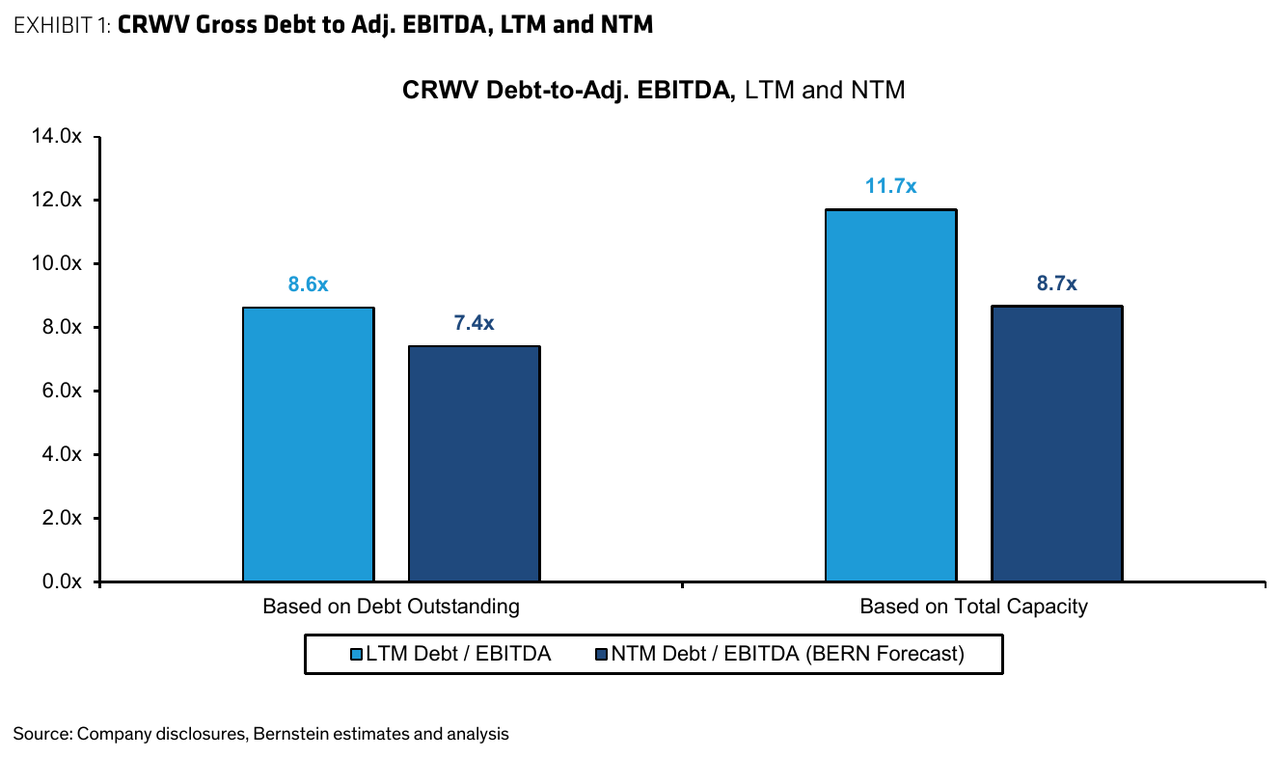
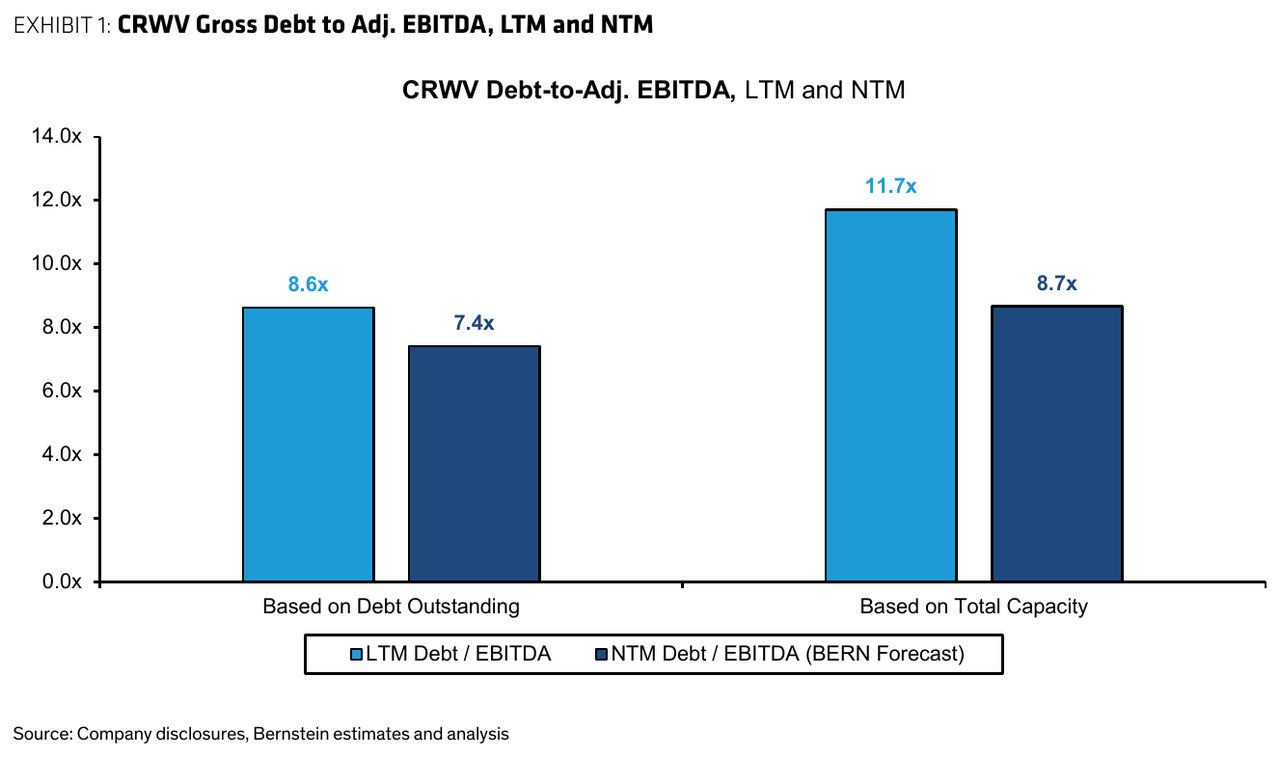
On Bernstein’s numbers, CoreWeave’s gross debt is 8.6x LTM adjusted EBITDA, or 11.7x on total committed capacity, and still 7.4x on next year’s EBITDA:
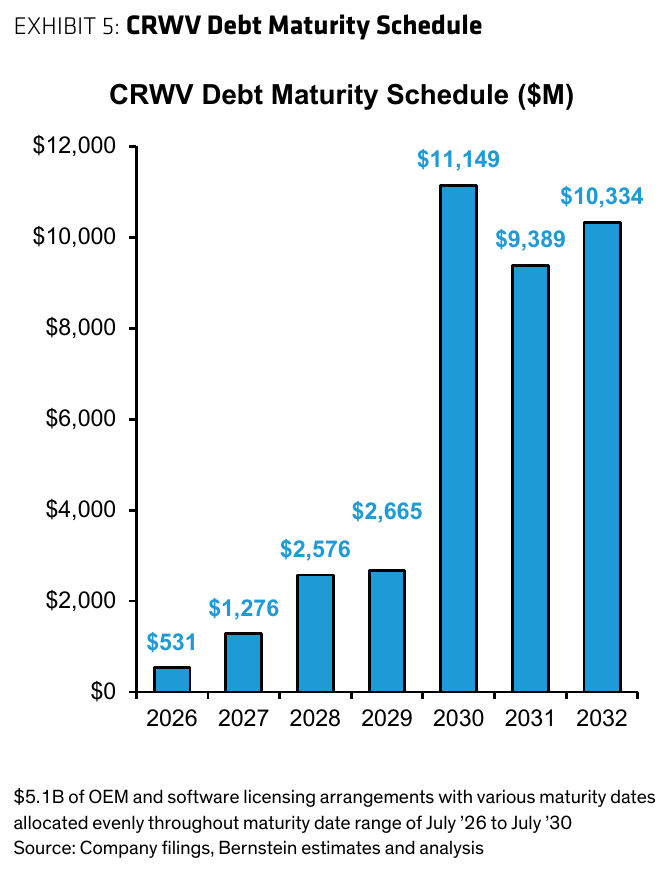
The good news is that most of the debt matures in 2030-2032 (about $31 billion in those three years), so Bernstein does not “expect the company to see real distress anytime soon.” The less good news is that the DDTLs are amortizing structures, and “principal repayments and covenant tests begin well before final maturity, making near-term debt service and covenant headroom important considerations.“
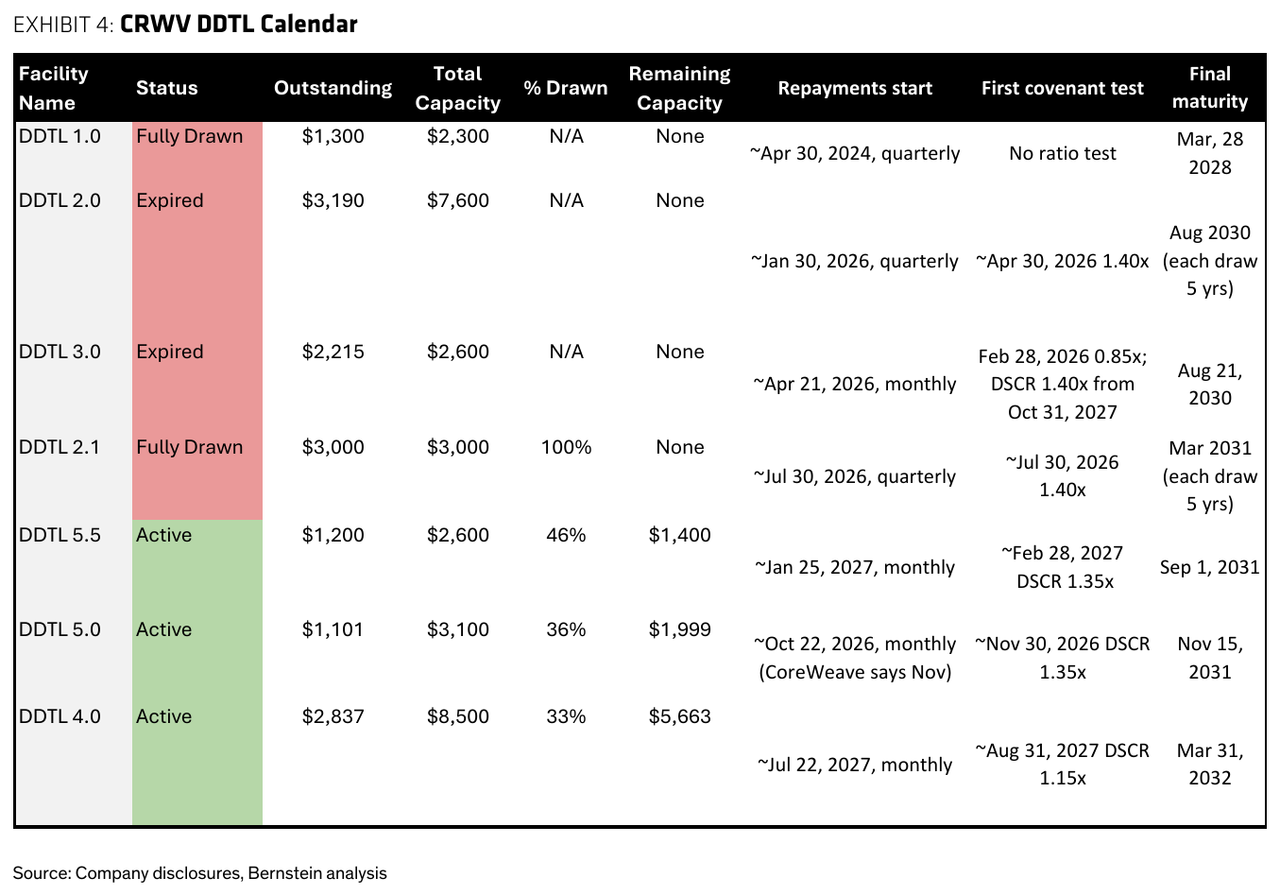
How near-term? According to Bernstein’s DDTL calendar, monthly repayments on DDTL 5.0 begin around October 22, 2026, i.e. today (CoreWeave says November), with the first 1.35x DSCR covenant test due around November 30. DDTL 5.5 starts amortizing in January, and the $8.5 billion DDTL 4.0 next July:
Then there’s the cost of new money. CoreWeave’s unsecured bonds yield around 15%, which Bernstein calls “an important signal of the market’s required compensation for risk,” and the most recent secured facility was hardly cheap either: DDTL 5.5, priced in August, came in at SOFR+5.50%, the widest spread since the very first DDTL in 2023. Bernstein thinks “subsequent deals could price even higher.“
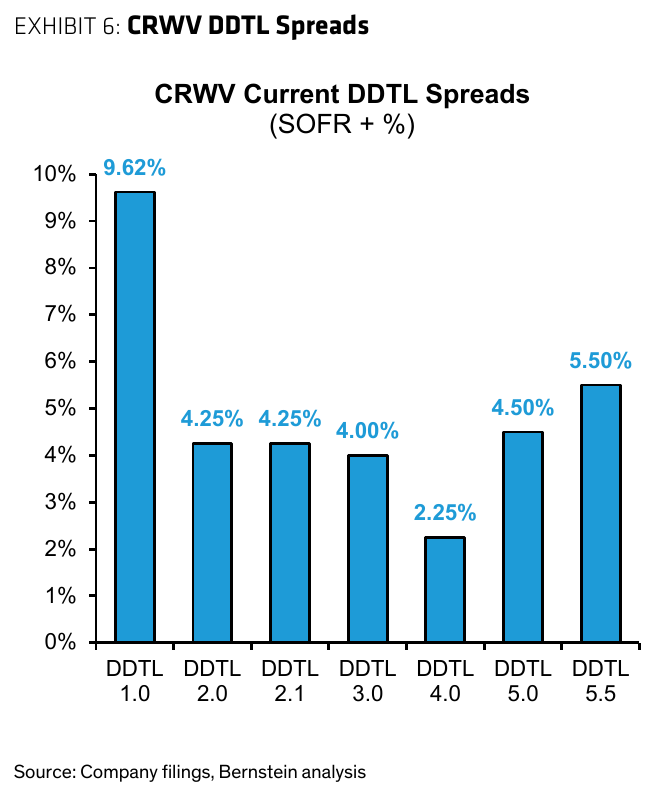
And here is the catch-22 at the heart of Bernstein’s thesis. CoreWeave needs to move toward shorter contracts with enterprise customers to remain competitive with hyperscalers (who are also its biggest customers and are building their own capacity). Shorter contracts capture higher pricing per MW. But…
“Unfortunately those contracts are riskier to creditors and do not help CRWV lower its cost of capital. DDTL 5.5 was at SOFR+5.5% – this is the best proxy; subsequent deals could price even higher.”
Put differently, the more CoreWeave does what it needs to do strategically, the more it costs to fund. Bernstein assigns “a low, nonzero probability” to CoreWeave building a sufficiently differentiated enterprise business, which is about as polite as sell-side prose gets.
A 9% Business With A 32% Story
Which brings us to returns. Bernstein runs the numbers on what it believes is CoreWeave’s best contract, the Meta deal (including the $21 billion expansion), and gets a best-case unlevered IRR of 9-12% (9% in its illustrative model). Levered, it jumps to 32%, which sounds great until you look at how it gets there:
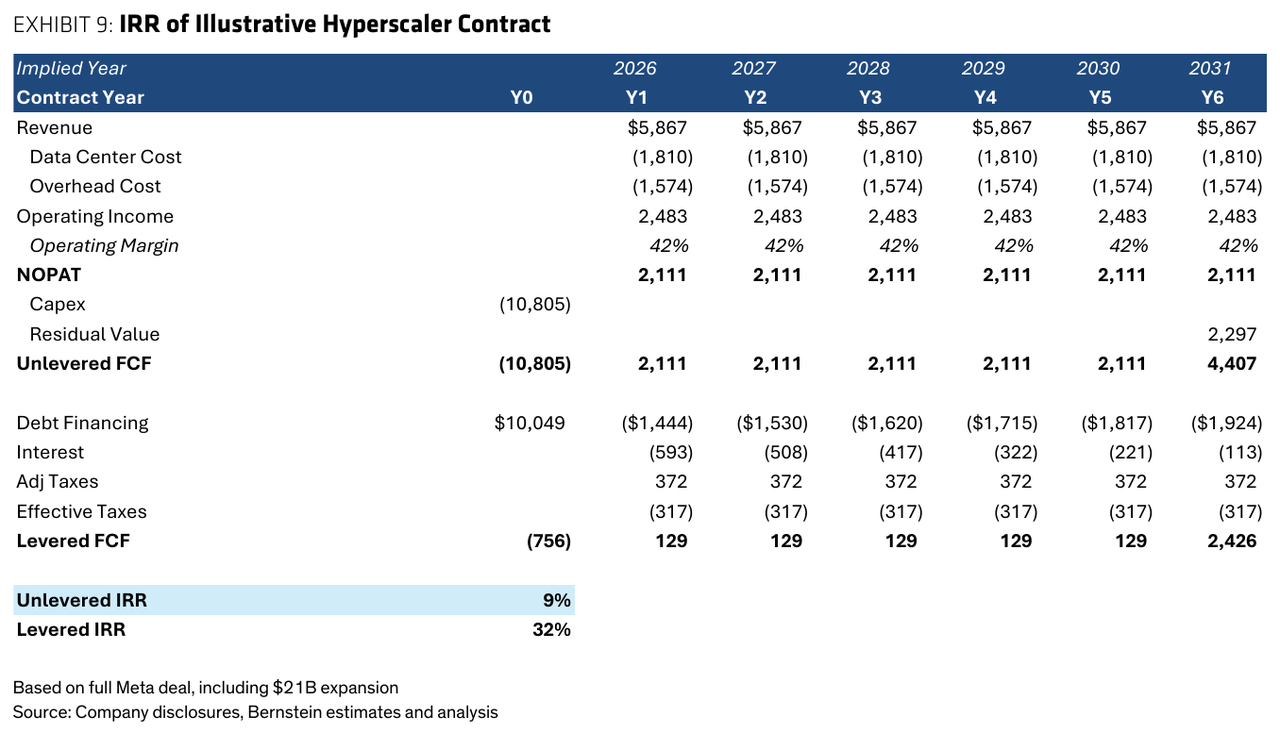
CoreWeave spends $10.8 billion of capex, borrows $10 billion of it, puts in $756 million of equity, and then collects… $129 million a year in levered free cash flow for five years, with the bulk of the return riding on a $2.3 billion residual value in year six. In other words, the 32% is almost entirely leverage plus a bet on what six-year-old GPUs will be worth in 2031. And that’s on 9% unlevered returns, against new money that costs 9% secured and 15% unsecured. HSBC made the same point on Tuesday with its 8.9% ROIC, and Bernstein’s math gets to the same place from a different direction.
Management says contracts signed since 2Q have “materially better economics.” Bernstein’s response is that the newer contracts “may be too small to change overall blended returns meaningfully,” and its “view leans toward medium-term economics resembling the older contracts more closely.“
Not A Zero… Just A Ward Of Jensen
To be fair to CoreWeave, Bernstein is not calling for a wipeout: “We do not believe CRWV is a 0 – they still have a large backlog, line of sight to powered shell delivery, and while we don’t think the contracts are super attractive, they’re not underwater.” Prediction markets seem to agree, at least after SpaceX’s blowout quarter:
stellar SPCX results sent Coreweave bankruptcy odds (by Dec 31, 2028) sharply lower https://t.co/Mjc8LU7xjp
— zerohedge (@zerohedge) October 21, 2026
The floor, in Bernstein’s view, is the same one that has been debated on these pages since the meltdown began last week: Nvidia. Asked whether Jensen would step in, Bernstein says “we think they would intervene in a true downside. Doesn’t necessarily re-energize the stock, but raises the floor.” Which is great news for CoreWeave shareholders, if a little awkward for Huang, who told everyone last week that CoreWeave’s cost of capital was “actually decreasing.” Well, no… it’s not of course, and as one of our contributors put it on Saturday, Jensen will blink first.
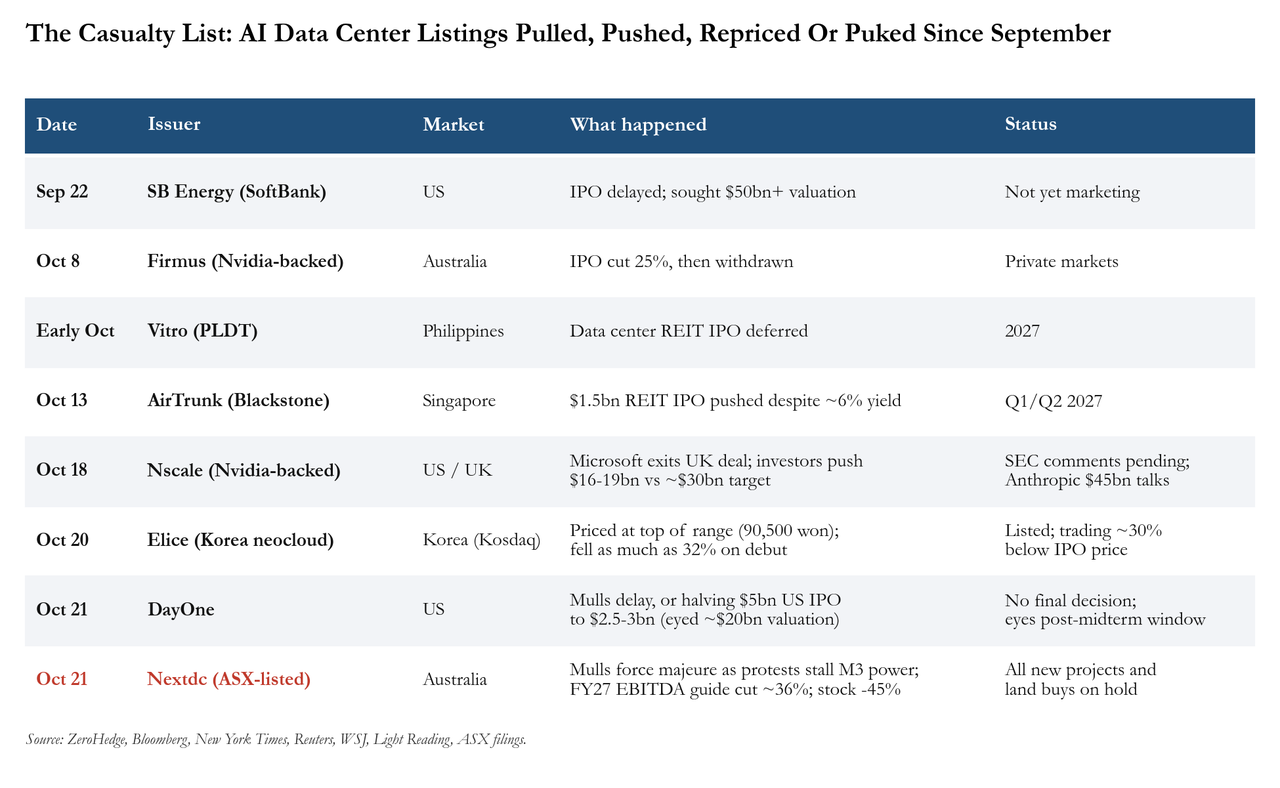
Bernstein’s other conclusion is that the damage is “semi-contained“: “If it ceased to exist tomorrow, colo contracts would be absorbed and the rest of the market would carry on.” We’d put more weight on the “semi” than the “contained.” CoreWeave is still the market’s beta barometer for AI credit, it’s the tenant on seven of the 20 project-finance data center bonds in the junk market, and the neocloud listings that tried to follow it to market keep faceplanting. Here is the latest casualty list:
Rezaei closes with what might be the most honest paragraph written about CoreWeave all month:
“We caught a lot of hate when we initiated on CRWV with a $56 price target seven months ago. Today, it’s a lot harder to find bulls – certainly some of them just don’t call us anymore, but there seems to be more broad acceptance of the challenges of this business model. Could this turn around? Maybe: it’s a wildly volatile, momentum-driven stock, but barring major moves, the fundamentals are probably stuck.”
So there you have it: one bank says CoreWeave’s funding gap is $23 billion if customers prepay, GPUs last six years and the stock goes back to $64; the other says $76 billion, at 15%, for a business earning 9% (obviously, one is wrong).
Goldman’s own model, meanwhile, quietly sides with the latter. Having warned since last October that AI had quietly become a debt bubble too, we know which spreadsheet we’d trust, and it’s probably not the one attached to a pending underwriting. The bills, as Bernstein puts it, still have to be paid, and the first DDTL 5.0 installment comes due right about now.
Much more in the full Bernstein “Core-We’ve got bills to pay… lowering our PT” note and Goldman’s “How big is the funding gap?“, both available to pro subs.
Tyler Durden
Thu, 10/22/2026 – 12:30
ZeroHedge News
[crypto-donation-box type=”tabular” show-coin=”all”]