 Don Draper
UNCLASSIFIED
A new think tank analysis finds a hypothetical blended-wing body tanker could offer twice as much refueling performance as the KC-46A Pegasus and recommends the Air Force buy scores of them, as the service prepares to evaluate a BWB demonstrator next year and must juggle its future tanker plans with a host of other modernization priorities like fighters and bombers.
The report, released by the Hudson Institute on Oct. 27, makes the case that the Air Force needs a fleet of 250 advanced new tankers to meet the challenge of refueling operations in a potential conflict with China.
Traditionally during conflicts, the Air Force has launched tankers from uncontested airfields relatively close to bomber and fighter strike objectives. But the vast distances of the Western Pacific and the long reach of China’s missiles make that untenable, report authors Timothy A. Walton and Shane Dennin write.
By 2035, they note, Chinese forces will likely be capable of suppressing large-scale tanker operations from “the forward and many of the intermediate airfields that tankers normally rely on,” a capability that “could collapse U.S. air operations and heavily contribute to U.S. defeat in a war against the People’s Republic of China,”
The solution, they conclude, are tankers that can launch from farther afield and carry more fuel to the fight.
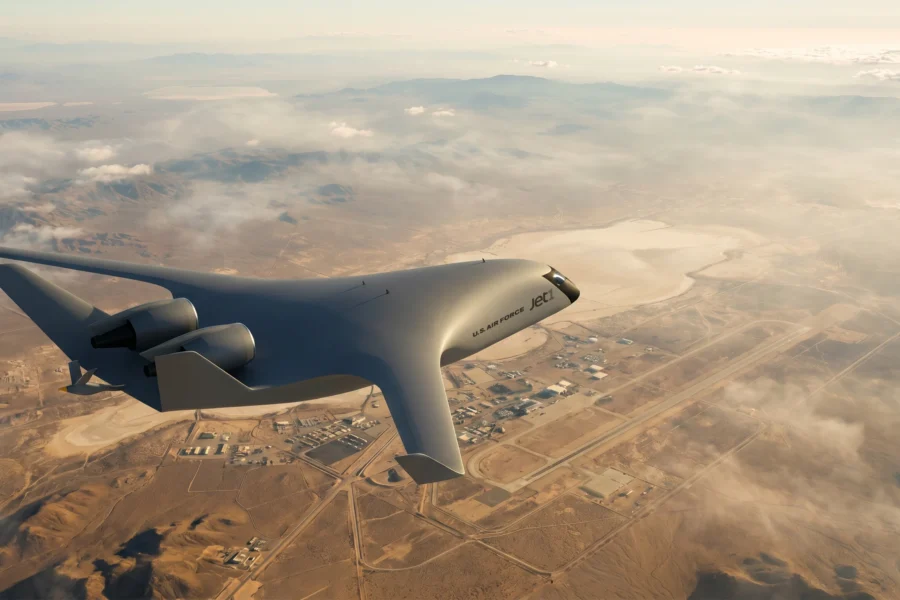
Blended-wing body aircraft blur the line between wings and fuselage for a design that is considered more aerodynamically efficient and has a large cabin/cargo space. The combination, the Hudson report concludes, means a “medium BWB can refuel more than twice as many force packages or refuel force packages more than twice as far as the KC-46A,” the report states. “At longer-ranges and higher offloads, the medium BWB can deliver up to five times as many operationally relevant increments of fuel as the KC-46A.”
Since 2023, the Air Force has been developing a BWB demonstrator/prototype program with startup JetZero, which is partnering with Northrop Grumman. That aircraft, dubbed Z4, is expected to make its first flight in 2027.
An Air Force spokesperson confirmed that the “blended-wing body project is currently active, on schedule, and meeting assembly milestones; the demonstrator’s first flight is scheduled for late 2027.”
JetZero has proposed a tanker variant, dubbed KC-Z4, though the demonstrator will not be a refueler.
The Air Force’s future tanker plans are not settled—the Eisenhower-era KC-135 fleet is showing its age, and officials have stressed the need for refuelers that can survive in contested airspace. At one point, they were exploring concepts through the Next-Generation Aerial Refueling System program, but they shifted gears in the 2027 budget request, saying they would focus on protection systems over a new aircraft.
Meanwhile, the service is still planning on buying up to 75 additional KC-46 Pegasus refuelers on top of the current program of record for 188. In May, the Air Force signed an agreement with Boeing to fix critical issues with the Pegasus, such as fielding an improved remote vision system that boom operators use to refuel other aircraft—a requirement that senior leaders have said must be resolved before the Air Force will sign the new contract extension to buy an extra 75 tankers.
The Hudson paper recommends the Air Force move forward with the KC-46 production extension contract. Then, assuming the BWB demonstrator evaluation goes well in 2027 and 2028, the service should direct fiscal 2027 research, development, test and evaluation funding to “mature medium-sized, long-range, high-offload capacity tanker designs, such as medium BWB,” the report states.
“Our proposed plan’s yearly tanker costs would require additional RDTE outlays in the late 2020s and early 2030s, but its total RDTE, procurement, and operations and support costs over 30 years could amount to $15.5 billion less than a plan that solely procured KC-46A,” according to the report, which compared acquiring and operating 250 Medium BWB tankers to the same number of KC-46s.
Retired Air Force Gen. Mike Minihan, who led Air Mobility Command between 2021 and 2024, said he saw the potential of the BWB demonstrator effort when it was conceived as a way to reverse the service’s neglect of tanker fleet modernization when compared to efforts to develop fifth- and sixth-generation bombers and fighters.
“One of my biggest concerns was the equilibrium of the strike force with the enabling force; I love B-21, I love F-15 EX, I love F-35, I love the [Collaborative Combat Aircraft], … but if we don’t invest in the enablers to make those things successful, we’re going to look silly on the modern battlefield,” said Minihan, who retired in 2024.
Minihan said his continued belief in the BWB design convinced him to become an advisor to JetZero earlier this year.
“It’s almost two times everything—two times fuel the efficiency, two times the amount of receiver service, two times quicker, two times the distance—I mean, it’s quite remarkable,” he said.
Douglas Birkey, Executive Director for AFA’s Mitchell Institute for Aerospace Studies, also noted the potential benefits of the BWB design.
“There is no question the Air Force needs new refueling capacity, and it needs to ensure that it can maximize offload range—you want to haul as much fuel as possible, not burn a whole lot on your way to the refueling track, offload as much as possible and then get back home,” Birkey said. “And the blended-wing body has definite, distinct aerodynamic advantages, being highly efficient to maximize that off-loader range.”
But Birkey said he is skeptical whether the Air Force can commit to a long-term funding plan for a next-generation BWB tanker in the current budget environment. The service’s $267.7 billion budget request in fiscal 2027 is $53 billion more than it 2026 budget, but even then, competing modernization priorities such as the sixth-generation B-21 bomber and F-47 fighter limited any investment in tanker fleet modernization. Buying a new fleet of BWB tankers would require even larger toplines of reliable funding over the next decade for the service.
“There’s got to be sustained long-term investment; this isn’t a one-year plus-up kind of investment. They need a decade’s worth of solid investment,” Birkey said. “They’re making up for so much underinvestment.”
For its report, Hudson evaluated the KC-46A, the Airbus A330 MRTT+, a medium-sized BWB design, a medium-sized reduced signature design, and a collaborative tanker aircraft—the latter two to theoretically shuttle tank from parent tankers such as the KC-46A at short-to-moderate distances. The KC-46A and A330 MRTT+ are medium-range, multirole designs while the Medium BWB is a long-range, high offload dedicated tanker. The medium BWB tanker is being designed to carry 300,000 pounds of fuel compared to the KC-46’s max capacity of 212,000 pounds of fuel. The A330 MRTT+ can carry 245,000 pounds of fuel.
Hudson concluded that the Air Force should take a holistic approach that includes:
- Prioritizing military construction and other funding to enhance capacity and resilience of its most important tanker airfields.
- Continuing to increase funding for command, control, and communications; self-defense; fuel transfer; and automation and autonomy mission systems for current and future tankers.
- Developing and procuring 250 medium-sized, long-range, high-offload tankers, such as the medium BWB, which could prove capable of standing in a moderate distance from threats.
The Air Force could begin fielding the new fleet of medium BWBs by the mid-2030s “for reasonable RDTE and procurement costs that align with projected budgets, and it could cost considerably less than simply buying more KC-46As,” the report states.
The report estimates that a mixed fleet with roughly 260 KC-46s and 250 medium BWB tankers would run $398 billion in totals costs over 30 years, while fielding an additional 250 KC-46s for a total fleet of 510 would cost $413 billion.
Both aircraft in the mixed fleet would complement each other, the report states: “Together, the force could succeed in its most stressing scenarios, as well as sustainably execute other operations across the world.”
Minihan said he agrees that the Air Force needs “bombers and fighters of fifth and sixth generation, but we generally don’t pay attention to the enabling force until it fails. … To think that we can take a four-generation gap between our strike force and our enabling force into combat with a near-peer adversary is a fool’s errand.”
Minihan said he was “on the record from my time in uniform as supporting” the medium BWB demonstrator effort. “It fits perfectly into the NGAS concept,” Minihan said. “Every pound of gas I save getting to the fight is a pound of gas I can give away to a fighter or a bomber.”
The post New Analysis: Air Force Should Buy 250 Blended-Wing Tankers, as 2027 Demo Looms appeared first on Air & Space Forces Magazine.
Acquisition, Air, aerial refueling, Air Force, Air Force tanker, Air Force tanker fleet, Air Mobility Command, AMC, blended wing body, Blended-Wing Body Jet, Gen. Mike Minihan, JetZero, NGAS
Air & Space Forces Magazine