 Tyler Durden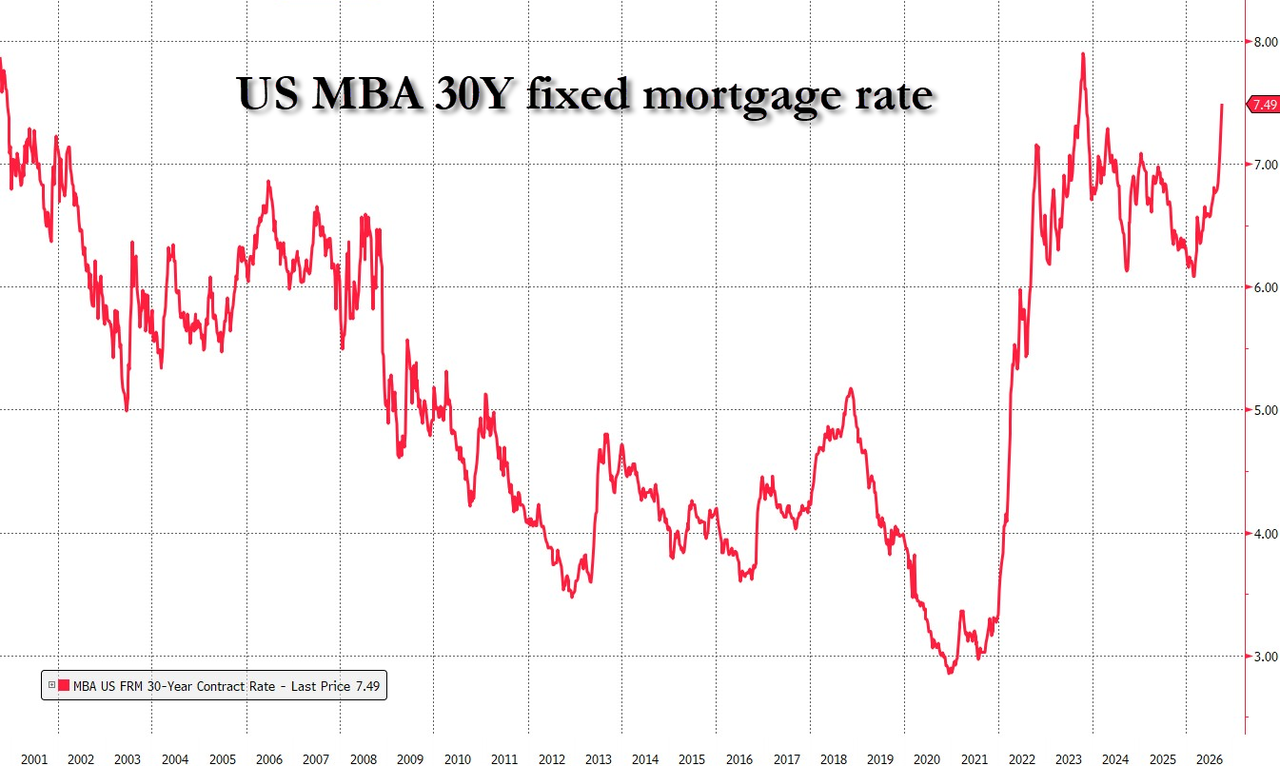
From 3-Year Lows To 3-Year Highs In Nine Months: Mortgage Rates Surge To 7.49% As Bond Rout Hits Main Street
Last December, we wrote that mortgage rates had dipped to 3-year lows. Nine months, one Middle East war and one global bond rout later, they are at 3-year highs.
According to the latest weekly data from the Mortgage Bankers Association, the average 30-year fixed-rate mortgage jumped another 19bps to 7.49% in the week ended October 2, the highest since November 2023, and up from 7.30% the week before, which itself was a fresh 3-year high.
The culprit is not exactly a mystery. Mortgage rates track the 10Y Treasury, and the 10Y just had its biggest quarterly jump since 1994, hitting 5.34% last week, the highest since 2002. And with the long end leading the latest leg of the selloff, this morning the 30Y climbed to 5.70%, also the highest since 2002, while the 10Y was trading around 5.32%.
Below we look at why the bond rout has finally landed on Main Street, what it is doing to housing (spoiler: nothing good), and why the sell-side’s perennial “yields will fall from here” call is now 0 for 9.
Follow The 10Y (Then Add A War)
As Reuters notes, home borrowing rates are up about 1.4 percentage points since US-Israeli strikes against Iran began in late February, closely tracking the jump in the 10Y yield, which was back above 5.3% on Monday. The drivers are the usual suspects: inflation fears from triple-digit oil (Brent was back above $101 this morning as Iran stepped up attacks on Hormuz tankers), surprisingly resilient growth, a Fed that is now hiking, and a bond market that has to absorb record Treasury supply and the AI debt binge at the same time.
And it’s not just a US story. On Monday, we put out this chart showing that global 10Y+ bond yields are now the highest since 2002:
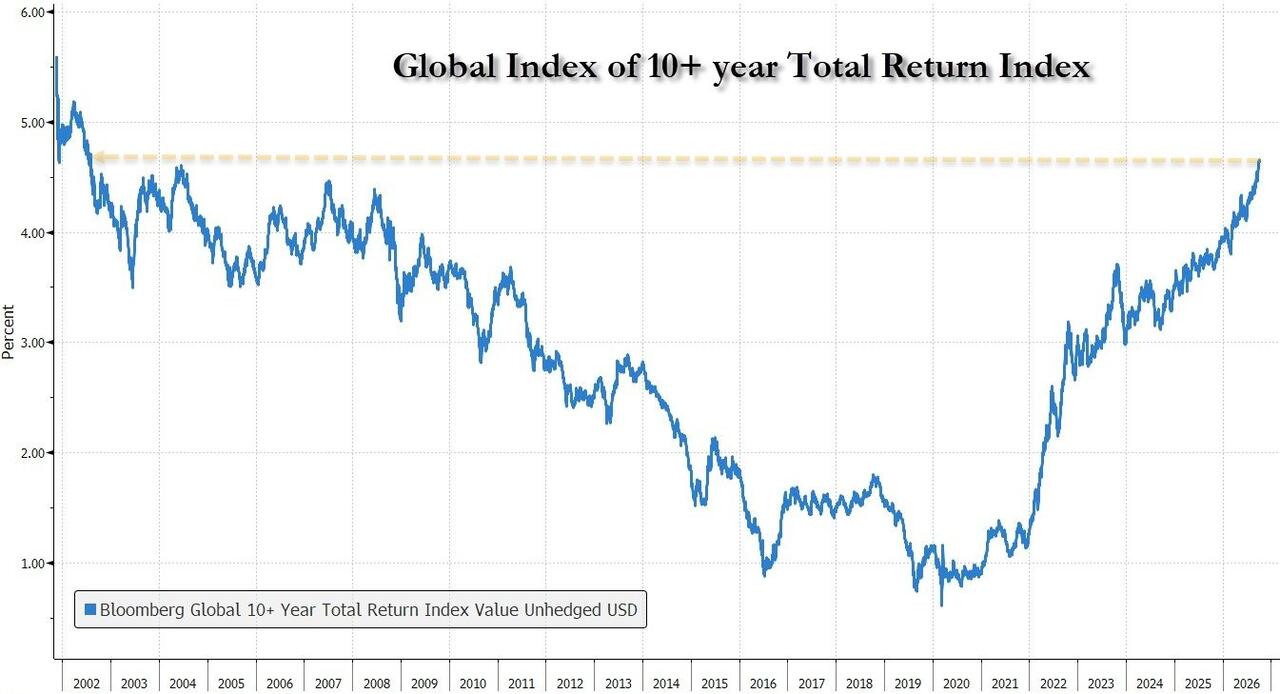
Since then it has only gotten worse: UK 30-year gilt yields hit a 28-year high this morning, while in France, where the OAT-Bund spread is back out to 140bps, European banks are tumbling as the French bond crash reactivates the “doom loop” (something we discussed earlier in “Bonds & Stocks Are Pricing A Fundamentally Different Macro Regime“). And as regular readers know, we’ve pinned much of the relentless Treasury selling on Japan, which has little reason to stop repatriating when its own long bonds yield near record highs.
Translation: the global bid for duration is gone, and the US homebuyer is the marginal price-taker. Yesterday’s subpar 3Y auction priced at the highest yield in 20 years as foreign demand slumped, and today the Treasury tries its luck with $39BN in 10Y paper at 1pm.
“Showings Have Stopped”… And So Have Applications
We have been tracking the slow-motion seizure of the housing market since late May, when refi activity plummeted as mortgage rates hit 9-month highs. By late September, homebuyers were turning to riskier mortgages as rates topped 7%, and last Thursday, after Freddie Mac’s 30Y rate posted its biggest weekly jump since October 2022 to 7.28%, real estate agents told us that “showings have stopped”.
Today’s MBA data confirms it. Mortgage applications fell another 4.2% last week, with refinancing applications dropping sharply. Overall application volume is now the lowest since February 2025, and has collapsed by nearly 50% since January. Or, in the dry words of MBA deputy chief economist Joel Kan, very few homeowners have an incentive to refinance “at these rates“, while the jump in borrowing costs has pushed many would-be buyers out of the purchase market altogether.
Some napkin math shows why. On a $400,000, 30-year mortgage, principal and interest at 7.49% comes to roughly $2,794 a month. At the ~6.1% that prevailed before the war, it was about $2,424. That’s $370 more every month, or 15%, for the exact same house – and 68% more than the borrower who locked in at the 2021 lows (who, naturally, is not selling).
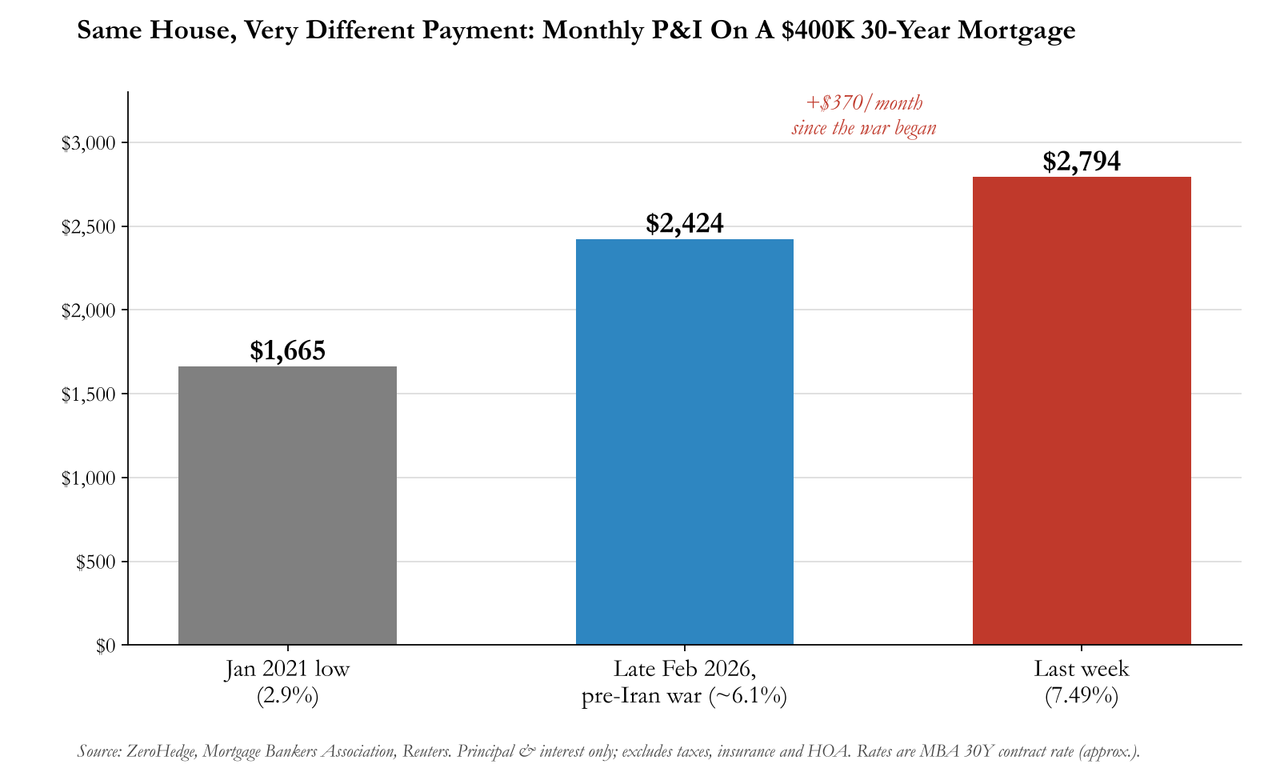
That last point is the real problem. The lock-in effect, which was finally starting to ease over the summer as inventory approached prepandemic levels, is now back with a vengeance: sellers with 3% mortgages have zero reason to move, and buyers facing 7.5% have every reason to wait. Even BofA’s REIT team, in its weekly U.S. REIT Weekly (available to pro subs), cites persistently high mortgage rates and elevated for-sale housing costs as a key reason renters are staying put longer – good news for apartment landlords; first-time buyers might see it differently.
Not that the administration isn’t trying. Just last Thursday:
*HASSETT: WE WANT MORTGAGE RATES TO GO DOWN
— zerohedge (@zerohedge) October 2, 2026
Mortgage rates rose 19bps that week. The bond market, it seems, did not get the memo, or more likely got it and sold anyway.
“Rates May Be Biting”
So where do we go from here? According to BofA’s rates team led by Mark Cabana, the selloff only ends when it starts to hurt. In his latest Global Rates Weekly, “Start of rates bite” (available to pro subs), Cabana writes that the impact of higher rates is starting to bite broader financial conditions, with spreads widening in OATs, the EU periphery and US high yield, before adding:
“Rates restricting financial conditions is a precondition for the selloff to stop (unless macro data softens first). Central banks are starting to push back but will only be credible if conditions stay tight / tighten further or upcoming data softens.”
In other words, the cure for high yields is… a housing market that stops working. Mission, at least partially, accomplished.
Notably, September’s selloff was concentrated in the US: BofA calculates the US 2-10Y sector rose 50bps last month, a 2x standard deviation move in the 10Y, as global central banks swung from pricing cuts in Q1 to 100bp+ of hikes in most regions. BofA still expects the Fed to hike 75bps between September and December, and only sees the 10Y ending the year at 5.00%.
Then there’s the mortgage-specific part of the equation. As BofA’s securitized team led by Chris Flanagan notes in its September returns review (also available to pro subs), Agency MBS delivered a -3.3% total return in September and -1.0% in excess returns versus Treasuries, underperforming even IG corporates (-2.6%). And the bank isn’t rushing to buy the dip: it stays “basis-neutral” on agency MBS and would only turn more positive if the current coupon spread, now 120bp, widens to the 125-130bp area.
Put differently, even the professional buyers of mortgage paper want more spread on top of a 10Y that is already at a 24-year high. Which means that unless Treasuries rally hard, the path of least resistance for mortgage rates is even higher.
Strategists: 0 For 9 (And Counting)
Of course, if you ask Wall Street, relief is just around the corner. In a Reuters poll of nearly 60 fixed income strategists conducted October 5-7, the median forecast has the 10Y easing to 5.00% by year-end, 4.90% in six months and 4.75% in a year.
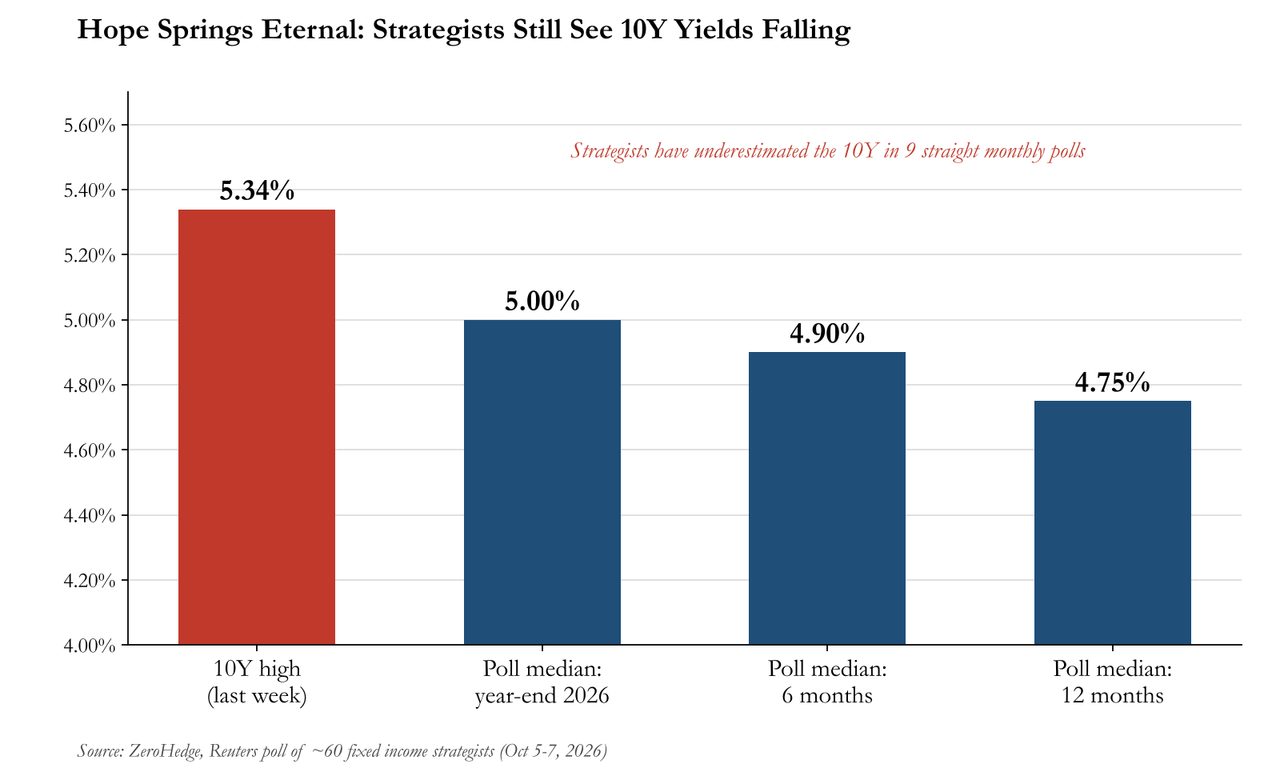
The same strategists have underestimated the 10Y in nine straight monthly polls this year, and got the direction mostly wrong in six of the most recent months. Perhaps sensing this, all but 2 of 30 forecasters surveyed said the 10Y is more likely to overshoot their forecast than undershoot it near term, which is a remarkably candid way of saying “we have no idea, but probably higher.”
The more honest take came from BofA’s own US rates strategist Meghan Swiber, who told Reuters rates have entered “a different regime” from anything since the GFC, and that a Fed which fails to tighten financial conditions will pay for it through higher long-term rates.
Midterm Math
All of this lands four weeks before the November 3 midterms. A Reuters/Ipsos poll completed Monday found the cost of living is the top issue on voters’ minds, which helps explain why Trump’s approval rating sits at a record low 32%. With PCE inflation at 3.4% in August and the Fed signaling another hike by year-end after September’s increase, the White House is running out of levers: today Trump said he is considering suspending the federal gas tax. Expect the “lower mortgage rates” talking points to get louder. Expect mortgage rates to ignore them.
Bottom Line
BofA’s Cabana frames the endgame neatly: the selloff stops when rates restrict financial conditions, or when the data rolls over first. In housing, that test is already being passed with flying colors: applications are down by half this year, showings have stopped, and refis have all but vanished.
The question is whether the bond market cares, after all it is financing AI hopes and dreams that may (perhaps) materialize sometime in the 2030s with an ROIC that isn’t negative triple digits. In other words, the runway for said hopes and dream is long and much more debt will flow before it reverses. Until then, however, broader rates will keep rising and rising, as the US now directly competes with data centers (most of which will never be plugged into a grid that simply can not support that kind of electricity demand) for funding.
With oil back above $100, the Fed hiking, Japan repatriating, France going all PIIGS on the OAT market and Treasury supply only going one way, we think the more likely outcome is that 7.49% is just another waypoint, and hardly a peak – and that the strategists’ “5% by year-end” joins the previous eight forecasts in the bin.
Then again, stocks closed at a record high yesterday, so maybe everything is fine… just don’t try to buy a house.
Much more in the full BofA Global Rates Weekly “Start of rates bite“, the Securitized Products “September 2026 returns” review and the U.S. REIT Weekly, all available to pro subs.
Tyler Durden
Wed, 10/07/2026 – 12:54
ZeroHedge News
[crypto-donation-box type=”tabular” show-coin=”all”]